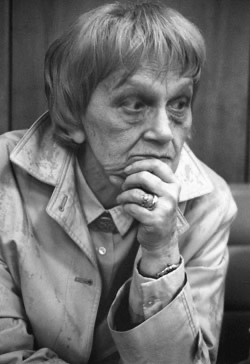
Dividing the Light from the Night:
The Poetry of Ágnes Nemes Nagy
by Pat Valdata
n his introduction to The Night of Akhenaton: Selected Poems, translator George Szirtes writes: "I have no doubt that Ágnes Nemes Nagy was one of the most important Hungarian poets of the post-war period. In fact, I have no serious doubt that she is far more than this: that she is one of the great indispensable European poets of the twentieth century" (7).
Although Nemes Nagy wrote in the Magyar language, her poetry has been made available to English-language readers thanks to translations by Bruce Berlind, Hugh Maxton, and George Szirtes, all of whom acknowledge how difficult the task of translation was. (Peter Zollman's translation of her poetry, 51 Poems, is no longer available in the U.S.)
Life
Ágnes Nemes Nagy (1922-1991) was born in Budapest, Hungary, a country that has a long tradition of writing poetry and honoring the poet. In fact, one of its national heroes is the poet Sándor Petőfi, a leading figure in the unsuccessful 1848 revolution against the Austrian Empire.
When Nemes Nagy was born, her parents were recent emigres from Transylvania, the part of Hungary that had been transferred to the newly formed Romania by the Treaty of Trianon in 1920. Her father was a lawyer. Although her parents had to leave everything behind and Nemes Nagy's early childhood was spent in extreme poverty, she grew up in a household full of music and books (Tezla 152). She wrote poetry in high school, and as a university student was working on a dissertation about poet Mihály Babits when World War II made continuing school impossible. She married literary critic Balász Lengyel during the war; in 1944, when the Hungarian Nazi Party took power, Lengyel deserted his army post and they fled to Budapest (Tezla 153). Nemes Nagy helped forge documents for friends who were Hungarian Jews (Lehóczky 9).
After the war, the Hungarian literary community was split. Writers from the lower social classes embraced Communism, which is not surprising because Hungary was one of the last European countries to end feudalism, and a strong class structure remained in place through the mid-20th century. Nemes Nagy was among the writers who were appalled by Hungarian fascism but who sought a new ethical and moral foundation outside of Communism (Tezla xxi).
From 1945 to 1948, Nemes Nagy's work was published in the influential literary magazine, Újhold (New Moon), which she co-founded with her husband. Her first book of poems, Kettös világban (In Two Worlds), was published in 1946 and won the Baumgartner Prize (Tezla 153). Winning the prize gave Nemes Nagy and Lengyel the means to travel for eight months in France and Italy during 1948. On their return to Hungary, they were shocked at the difference in their country. In an essay, Nemes Nagy explains that:
Of course, we had heard about the Hungarian news and about the year of change. Yet we did not know what it meant. We did not understand what had happened; we were too busy with Roman antiquity, Picasso, and the world in general. And we returned here, the place where Újhold was banned, where we as writers were banned…. (qtd. in Lehóczky 161).
What had happened was the Communist takeover of Hungary, 100 years after Hungary's first bid for independence. Under Stalinist Communism, poets and writers had to produce didactic, "Socialist Realism" pieces or cease publishing (Tezla xxii). Socialist Realism, a Soviet concept introduced in 1934, maintained that "[t]ruth and historical concreteness of artistic portrayal must be combined with the task of ideologically transforming working people and educating them in the spirit of socialism" (Zhdanov, qtd. in Lehóczky 162). In other words, poets and writers had to produce propaganda.
Nemes Nagy and Lengyel chose not to do so. As punishment, he was imprisoned for several years, and she was not allowed to publish her own poetry from 1949 to 1957 (Makkai 805). During that period, she would write only children's books and translations of Western writers, notably the plays of Molière, Corneille, Racine, and Brecht, and the poetry of Dylan Thomas and Rainer Maria Rilke. Rilke would become a major influence on her work (Makkai 805). In 1956, during the month-long Hungarian Revolution, Nemes Nagy, Lengyel, and two friends narrowly escaped being killed by members of the State Security Authority, who had hidden in an ambulance before leaving the vehicle and opening fire on civilians (Lehóczky 167). She would later incorporate this incident into one of her poems, "The Night of Akhenaton":
He leapt across some rails along
with all the others,
together they rolled down an embankment,
piecemeal, jerkily, tumbled
under continuous gunfire, over each other
like an avalanche. 53-58 (Tr. Szirtes)
In this poem, the pharaoh serves as a persona for the poet. She depicts him walking through a street festival on All Souls Day, as she and her friends had done, when "the tanks were already coming" (43 Tr. Szirtes).
The slightly more liberal regime that came into power after the failed revolution allowed increasing freedom to writers. Nemes Nagy's second book of poems, Szárazvillám (Dry Lightning) was published in 1957. It was followed by Napforduló (Solstice) in 1967; A Lovagok es az angyalok (The Horsemen and the Angels) in 1969, which won the Attila József Prize; Ékszakai tölgyfa (Night Oak) in 1979; Között (Between) in 1981; and her collected poems, A Föld emlékei (The Earth Remembers) in 1986.
Although she published only five books of new poetry, Nemes Nagy was a prolific prose writer. In her bibliography, Lehóczky lists four pages of essays and interviews. In his preface to Lehóczky, Szirtes notes that the Collected Poems, published after her death, has only "132 pages of poems published in book form in her life time, the rest of the 300 odd pages being unpublished, posthumously collected work composed of sketches, commemorative verses, and some reflections" (xv).
In 1983, Nemes Nagy received Hungary's highest artistic honor, the Kossuth Prize, but according to Bruce Berlind, who translated Selected Poems, published by the University of Iowa, "[s]he interpreted it as an act of cynicism on the part of the authorities. She told me that the powers were trying to make themselves appear more tolerant than they actually were" (8).
She died of cancer in 1991.
Work
Nemes Nagy's poetry is as hard to classify as it is to translate. László Cs. Szabó writes that her work has "a high-temperature, condensed, enigmatic terseness" with "passions…projected from a rationalist mind" (Makkai 937). Hugh Maxton, who translated a selection of her poems in the volume Between, observes in his "Commentary" that "[i]ntellectual passion is its essence" (79). He also identifies her as a modernist/classicist (81), whereas Lehóczky sees Nemes Nagy as a postmodernist, which she explains in detail in her book of essays on Nemes Nagy's work, Poetry: The Geometry of the Living Substance. Berlind sees Nemes Nagy's poetry as "uniformly subversive, although it is often difficult to say why that is so, to pinpoint what specifically is subversive about it" (5).
The difficulty is twofold. One is the language itself. Magyar is not part of the large Indo-European language family. An inflected language, it is notoriously difficult, and although all translations have their problems, Magyar has no gender, making the choice of pronoun especially fraught. Also, the language has many more rhyming words than English. Even poems that are metrically free tend to have rhyming lines.
The second difficulty stems from Nemes Nagy's imagery. Although her poetry is full of images from nature—in particular, trees, birds, Lake Balaton, rocks, mists—Szirtes cautions that "[n]one of this is cuddly" nor is it "tender, sweet, or maternal"(9). There's a tension in her work between the pragmatic Calvinist and the mystical visionary, between the intellectual and the emotional, the personal and the political. In fact, almost all her work involves a tension of some kind, displaying objects or states of being that are between one thing and another. Trees, for example, are "objects between the earth and sky….Mist, in this calculus, is not a blurring of vision; it is a state of transformation, with 'between' ultimately the most manifest and the most inexpressible element therein" (Maxton 83).
Her poem "Fák" ("Trees") illustrates this tendency:
Fák
Tanulni kell. A téli fákat.
Ahogyan talpig zúzmarásak.
Mozdíthatatlan függönyök.
Meg kell tanulni azt a sávot,
hol a kristály már füstölög,
és ködbe úszik át a fa,
akár a test emlékezetbe.
És a folyót a fák mögött,
vadkacsa néma szárnyait,
s a vakfehér, kék éjszakát,
amelyben csuklyás tárgyak állnak,
meg kell tanulni itt a fák
kimondhatatlan tetteit.
Trees
It's time to learn. The winter trees.
How head to toe they're clad in frost.
Stiff monumental tapestries.
It's time to learn that region where
the crystal turns to steam and air,
and where the trees swim through the mist
like something remembered but long lost.
The trees, and then the stream behind,
the wild duck's silent sway of wing,
the deep blue night, white and blind,
where stand the hooded tribe of things,
here one must learn the unsung deeds
of heroism of the trees.
tr. Szirtes
Nemes Nagy asserts that trees inhabit this in-between "region where / the crystal turns to steam." Their hard trunks are both coated in frost and swimming in a mist. They form both a barrier and an entryway to nature. Their longevity makes them witnesses to the centuries of invasion that Hungary had experienced from the Middle Ages to those Soviet tanks rumbling through Budapest in 1956.
Nemes Nagy makes this state of between-ness explicit in her poem titled, appropriately, "Between." Here she contrasts life between "the earth and sky," "the day and night," "sky and sky":
These decimations and incisions
droughts and visions,
inarticulate resurrections,
the unbearable vertical tensions
between up-above and down-below—
Various climates and conditions.
Between. The stone. The tracks of tanks. 37-43 (tr. Szirtes)
This state of between-ness is also central to her poem "Statues." In this poem, the speaker falls down a hillside toward a beach full of statues and assorted junk. While lying at "the cliff's broad foot," the speaker addresses a "you" who seems to be both human and statue:
No one more stubborn than you, none,
you who cast yourself in stone,
into object, into stone
your live neck and backbone,
this is an age of stone, an age,
a blind life of diminished sense. 30-35 (tr. Szirtes)
Berlind calls this poem "terrible and bitter" in his introduction to Selected Poems, in which the speaker is as much an "artifact" as the statue, "with just enough human consciousness to perceive their helpless condition but without the capacity to rectify it" (Selected Poems 6). Even more, he recognizes that the poem is "as direct a response to the totalitarian regime as the regime was likely to tolerate" ("Poetry and Politics" 5). Berlind had met with Nemes Nagy in 1977, in Budapest, along with an "Americanist" professor who was in fact a Communist Party member. Luckily for Berlind and Nemes Nagy, the "Americanist" specialized in Colonial American literature and "was totally perplexed by the poem" ("Poetry and Politics" 5).
Objects like statues play an important role in all of Nemes Nagy's poetry. She thought that every object could be used to express a quality because objects were "imbued with a certain kind of spirit, a certain soul" (qtd. in Tezla 154). Tezla writes that:
her increasing use of concrete objects, often descriptively, endows her verses with an impersonality and intellectuality suggestive of the metaphysical poets. Driven by the impulse to think and thus to fix her eye on a reality between anxiety and knowledge, she purposely reduces personal elements in her poems, choosing images of nature, urban life, and science with their own "spirit" instead of stating her thoughts and emotions abstractly. (154)
Considering the repressive political climate in which she lived and published, it is not surprising that Nemes Nagy chose to write obliquely. In her essay "Elusive Apple," Nemes Nagy explains her work as a balancing act between "the joy of the word and the inadequacy of the word":
It is a delicate balance: a narrow path between two cliffs. Or, put another way: it is the duel of the unequivocal word and the unarticulated general condition, the corralling of these "between" states, which is, for me, poetry. But how would poetry not be at least two-fold, when life itself is that? Our every moment and our entire existence is the crossroad of contrasts—as the philosopher of the Renaissance stated—or, if you wish, it is the intersection on the highway of facts and ideals, or the airport of the contrailed meetingplaces [sic] of earth and sky. (qtd. in Tezla 176)
Although Tezla calls her poems impersonal and intellectual, Nemes Nagy herself writes, "I am not afraid to call the poet the specialist of the emotions" (qtd. in Lehóczky 82). Her choice to express those emotions through the use of objects, and later through the avatar of Akhenaton, reflect the distancing needed by someone who survived a world war and a failed revolution (not to mention a failed marriage).
Nemes Nagy chose Akhenaton as a persona because he was a cultural and religious reformer. He was the Egyptian pharaoh who established monotheistic worship of the sun god, Aten (also spelled Aton), around 1353 BC. He also moved the Egyptian capital and instituted a new style of art. His changes were radical but fleeting, and Egypt reverted to its old ways after he died after 17 years as pharaoh, and his heir, Tutankhamun, ascended to the throne.
Akhenaton resonated with Nemes Nagy when she was contemplating aging, mortality, and how "to live within difficult life conditions," as she described the 1956 Hungarian Revolution during a 1980 interview with poet László Lator. Because Hungarian has no gender, the "I" of a poem can be both Akhenaton and Nemes Nagy (Bryant and Eaverly). She said that she "felt that the Akhenaton character was capable of carrying the polysemic and indefinable problem of the 20th century individual, which may be called metaphysics without the metaphysical" (qtd. in Lehóczky 55). The first poem in the sequence, "From the Notebooks of Akhenaton," is written from the point of view of Akhenaton calling his sun god into being, but it also can be read as Nemes Nagy calling this persona into being:
Enough. Proclaim how good it is,
perform your mighty offices,
sit, stare, eternally in state.
Begin. It is already late. 18-21 (tr. Szirtes)
"The Night of Akhenaton," referenced above, puts Akhenaton in Budapest on a night of violence. After escaping the gunfire, he rises next to or emanating from a dead body like smoke, carrying that body "through horizontal lines of attenuated mist." It seems clear that Nemes Nagy is referring to the memory that she carries of bodies that she saw and even buried during the war.
In the final poem, "Akhenaton in Heaven," she portrays her persona as a geologist tapping a limestone cliff at sunrise:
As if it were dawning from within,
the whole cliff like a narrow sheet,
stone and iron transparent now and thin
after ultimate defeat. 4-7 (tr. Szirtes)
The poem contains familiar images: a forest, fog, and a narrow-gauge railway whose "sleepers" evoke the dead, which ends at a field of chamomile flowers:
the air above them thick with pollen,
the white spokes of vegetative suns,
unruffled galaxies, no wind whatever.
Noon. For eternity. For ever. 37-40 (tr. Szirtes)
Akhenaton has moved from the perilous cliff face at dawn through the forest, along the rail tracks, into this peaceful field where the sun is at its zenith, always. Akhenaton is, at last, at rest with his god.
While gods and pharaohs sleep, humans must rise from the ashes of war and revolution. Nemes Nagy's short poem, "Lazarus," begins after the Biblical miracle has occurred:
Lázár
Amint lassan felült, balválla-tájt
egy teljes élet minden izma fájt.
Halála úgy letépve, mint a géz.
Mert feltámadni éppolyan nehéz.
Lazarus
As slowly he sat up the ache suffused
his whole left shoulder where his life lay bruised,
tearing his death away like gauze, section by section.
Since that is all there is to resurrection.
(tr. Szirtes)
Anyone of a certain age can appreciate the aches that Lazarus feels when he gets up, slowly, after lying dead for so many days. And how wry of Nemes Nagy to present what is supposed to be a glorious miracle in such mundane images. Resurrection is no big thing, after all, since it brings us back to this difficult world we live in.
She is masterful at combining the astounding and the everyday. In "Night Oak," a vagabond walking one night hears a noise behind him, and sees an oak tree coming his way. He stops to wait for this "awkward mermaid" who comes toward him "dragging on raw roots" and "still shedding earth" (Night, 54). When the tree gets to him, she leans seductively against a lamp post and pushes her "hair" aside. As they stare at one another, "The night walker felt his own / contours grow slack, / his dissolving coastline swimming in fog" (Night, 54). This scene is another, eerie example of between-ness, with the man almost becoming one with the tree through the medium of water. But nothing happens. The oak tree "[l]et fall its curtain of hair. / Turned round. Set off. Strange footed" (Night, 54). As the man re-solidifies, he sees the oak tree go back into "the hole in the ground / which was ready to receive it" (Night, 55).
It's an odd poem, which can be read as a parody of a streetwalker soliciting a john, but there's nothing carnal about this encounter. Instead there's an attempt at a spiritual merging of the human and the natural, but unlike a Romantic poet (or the ancient Greeks) who would let the encounter take place, Nemes Nagy pulls the man and tree apart, because as much as we would like to become one with the Other, she knows we cannot.
Nemes Nagy, living most of her life under totalitarian rule, was above all a realist, no matter how magical her poems seem to be. Informed by her participation in a failed revolution and having to live through the aftermath, how could she be otherwise? Her country had only decades before traded the oppression of feudalism for the oppression of fascism and then of Communism. Her poetry could have been bleak; it is instead filled with ambiguity and imagery, and all the richer for it.
Poems
Szobrok
Keserű.
Keserű volt a tenger, amikor
a sziklatorkon legörögtem,
csigalépcsőn kavics, pörögtem,
búgott a csigahéj utánam,
mint az emlék a puszta házban,
zörögtem,
mint vasszilánk a koponyában.
Aztán kigurultam a partra.
És szobrok voltak ott.
Egy talapzaton,
bőrrel fedett teknőctojás:
koponyám forrt-forrt a napon,
elgurult fehér sisakom
egy buborék a homokon,
feküdtem, sziklát ért a vállam,
mocskos, mocskos fehér ruhában.
Kíé ez a tömb?
Ki volt, aki hegynyi palából
irtózatos indulatával
hasogatta ki ezt a közönyt?
S a bádogok rajtam, a bádogok.
Horpadt szelencék,
amint a fényt dadogva visszaverték,
egy repülőgép roncsa fénylik így,
de bent még mozdul, ami él,
karóraszíjon némi vér,
feküdtem a sziklára kenve,
az elevenség mocska a kövön.
Nincs makacsabb, makacsabb,
egy kőbe dobod magadat,
egy tárgyba dobod, egy kőbe dobod
eleven nyakadat,
ez már kőbeli évszak,
lecsavarva az élete félvak,
ki véste ki ezt a közönyt?
Ki volt, aki hegynyi palából
eleven nyakadat?
Só és homok és fent a kőtömb,
mint egy barlang az égbe vájva,
ez a viszonylagos öröklét,
ez az ásványok félhomálya—
zúg, zúg a víz, egy Föld az ágya:
keserűsége kőedényben.
Ekhnáton az égben
Ott minden épp olyan. A bánya.
Talpig hasadt hegyoldal. Eszközök.
Amint tapintja a mészkőfalat:
bizonytalan a pirkadat.
Mintha belülről hajnalodna,
a sziklák vékony oldalán,
s oly áttetsző a kő, a vas,
mint egy végső kudarc után.
Ott az erdő.
Darabokban jár a köd.
Őtujjasan, mint elhagyott kezek,
vagy fölnyúlnak függőlegesre,
már-már uszályos mozdulat,
s jelentésükig el nem érve
halványan folynak a földre,
ahogy vonulnak—
ahogy kinőnek és ledőlnek
ezek a felhős, hosszú törzsek,
egy másik erdő jár a fák közt,
s egy másik lombot hömpölyögtet.
Ott alagút a fák alatt.
Sötét füvek, kavics:
keskenyvágányú sínpár, virradatban.
Ott már a nap, jön gőzölögve,
oldalt hasít be a ködökbe,
jön-jön a néma robogás,
fölszikrázik a fű-alatti fém,
szikrázik a reggel,
míg egy bokor-fal váratlan szökik fel,
mert végetér a sín a fű alatt.
És aztán néhány talpfa csak,
mint néhány zökkenő lépés előre—
a tisztáson megáll a nap.
Ott délelőtt. Ott nagy növények.
Ott nem mozdul a nagy kamilla-rét,
közötte néhány vasdarab,
fölötte lépes sűrűség,
fehér-küllős növény-napokkal
hullámtalan Tejút és semmi szél.
Mindig. örökre. Dél.
Éjszakai tölgyfa
Éjszaka történt, hogy a járókelő
valami zajt hallott és visszafordult:
egy tölgyfa jött mögötte.
Megállt, bevárta. úgy jött ez a tölgy
ahogy gyökereit frissen kihúzta
s még földes, hosszú kígyólábakon
hullámzott az aszfaltos útra,
mint egy idomtalan sellő, igyekezett,
túlságosan széles feje súrolta
a néma boltredőnyöket,
mikor elérte a járókelőt,
a lámpaoszlopnak mindjárt nekidőlt,
aztán haját széthárította.
A haj mögül egy tölgyfa arca nézett.
Nagy, mohos arc. Talán. Vagy másmilyen.
Érezte akkor a járókelő
saját körvonalait lazulni,
köd úszta be folyékony partjait,
mint aki hirtelen erdei
tóvá sötétül,
mert egy ilyen arcot tükrözhetett.
És lélegeztek mindaketten.
Néhány madárfészek a tölgy hajában,
bennük alvó madár, mintegy gondatlanul,
ott-feledetten.
Mert sürgető volt.
Oly sürgetően állt ott mozdulatlan,
mint egy hír, tölgy-alakban,
amely elfárad megfejtetlenül.
Hajfüggönyét visszaengedte már.
Megfordult. Indult. Furcsa lába.
Vitte fészkeit, madarait,
s a járókelő
szilárduló szeme előtt
fénnyel szórta a neonlámpa-sor.
Már várta az elhagyott gödör,
amelybe visszaforr.
Között
A levegő nagy ruhaujjai.
A levegő, amin szilárdan
támaszkodik madár s madártan,
az érvek foszló szélein a szárny,
egy percnyi ég beláthatatlan
következményű lombjai,
az élő pára fái, felkanyarodva
akár a vágy, a fenti lombba,
percenként hússzor lélegezni
a zúzmarás, nagy angyalokat.
És lent a súly. A síkon röghegyek
nagy, mozdulatlan zökkenései,
amint feküsznek, térdenállnak
az ormok és a sziklahátak,
a földtan szobrai,
a völgy egy percnyi figyelem-lazulás,
aztán megint a tömbök és a formák,
meszes csonttól körvonalig
kővé gyűrődött azonosság.
Az ég s a föld között.
A sziklák roppanásai.
Amint a nap átlátszó ércei
már-már magukba, fémmé a követ,
ha állat járja, körme füstölög,
s köröznek fent a sziklafal fölött
az égő paták füstszalagjai,
aztán az éj a sivatagban,
az éj, amint kioltja s kőmivolta
magváig ér, fagypont alatti éj,
s amint hasadnak és szakadnak
a porcok, forgók, kőlapok,
amint feszítik véghetetlen,
széthasgató önkívületben
a fehér s a fekete mindennapos
néma villámcsapásai—
A nap s az éj között.
A szaggatások, hasgatások,
a víziók, a vízhiányok,
a tagolatlan feltámadások,
a függőlegesek tűrhetetlen
feszültségei fent és lent között—
Éghajlatok. Feltételek.
Között. Kő. Tanknyomok.
Egy sáv fekete nád a puszta-szélen,
Két sorba írva, tóban, égen,
két sötét tábla jelrendszerei,
csillagok ékezetei—
Az ég s az ég között.
Statues
Bitter.
Bitter the ocean when I rolled
down the cliff's throat, a pebble stumbling
down spiral stairs, and as I fell
I heard the empty shell
like memory in an empty house behind me humming,
and I rattled
like loose metal, shrapnel in the skull.
Then I tumbled out across the beach
to find the statues.
There, on a sculpted base
a turtle's egg with its own carapace:
my skull simmering in heat of day,
my white helmet rolled away,
a tiny bubble in the sand,
I lay, my shoulders against the cliff's broad foot
filthy, filthy in my stained white suit.
Whose is this block?
Who was it who from this mountain of slate
furiously carved an extraordinary state
of indifference out of rock?
And tin, small shards of tin all over me,
buckled tin cans, metal panes
that, stuttering, beat back the light,
brilliant as the wreck of a downed plane,
something still living moving within,
a watchstrap, bloodstained,
I lay there spread against the cliff
an animated filth laid over stone.
No one more stubborn than you, none,
you who cast yourself in stone,
into object, into stone
your live neck and backbone,
this is an age of stone, an age,
a blind life of diminished sense.
Who carved out such indifference?
Who was it carved that living weight
of neck out of this heap of slate?
Salt and sand, the mass of rock above,
cave carved in sky,
this relative eternity
these minerals in twilight dress—
The sea booms out, one Earth its bed:
a stone bowl for its bitterness.
Akhenaton in Heaven
There everything is as it is. The mine.
A mountainside cleft to its heel. The instruments.
As he gently taps the limestone face
dawn shakes, uncertain of its place.
As if it were dawning from within,
the whole cliff like a narrow sheet,
stone and iron transparent now and thin
after ultimate defeat.
There lies the forest.
The fog proceeds in chunks.
Five-fingered, like abandoned hands,
or stretching upward, vertical,
they're tugged along as if by hawsers,
and, failing to gain a meaningful stature, are found
trickling faintly along the ground,
so they proceed,
and so expand or fall in broken ranks,
cloudy, attenuated trunks,
an alternative forest moving between the trees,
billowing mock boughs and shrubberies.
A tunnel there under the trees.
Shady grasses, gravel:
A narrow gauge railway, and now daybreak.
the sun arriving on a head of steam,
slicing the fog neatly, beam by beam,
sun on its way, as its mute rumbling shows,
the metal under the grass sparkles and glows,
the whole morning glows,
while a wall of bushes suddenly rises up,
where the rails have stopped under their grassy bed.
Then only a few sleepers lie ahead,
like halting steps to be negotiated,
and a clearing where the sun stops dead.
It's morning there. Enormous plants.
The camomile field still and solemn,
hoarding a few scraps of iron,
the air above them thick with pollen,
the white spokes of vegetative suns,
unruffled galaxies, no wind whatever.
Noon. For eternity. For ever.
Night Oak
Night-time: the walker,
hearing a sound, turned round to see
an oak tree in pursuit.
Stopped and waited for it. The oak
proceeded dragging on raw roots
still shedding earth, wriggling long serpentine limbs
down the metalled road,
an awkward mermaid thrusting forward,
its crown too broad, brushing against
silent awnings,
and having reached the night walker
it stopped to lean against the lamp post
push hair aside.
Behind the hair an oak tree's face looked out.
Huge face of moss. Perhaps. Or something like.
The night walker felt his own
contours grow slack,
his dissolving coastline swimming in fog,
like one darkening
in a hidden tarn in a forest,
this was the face he reflected.
Both paused, took breath.
There were birds' nests in the oak's hair,
and in them, sleeping birds, unaware
unremembered.
Because the matter was urgent.
It stood there motionless and urgent
like a news item in oak form,
which states, uninterpreted.
Let fall its curtain of hair.
Turned round. Set off. Strange-footed.
It took its nests and birds
and before the solidifying eyes
of the night walker
neon signs sprinkled light in it,
and melted back into the hole in the ground
which was ready to receive it.
Between
The air's enormous empty sleeves.
Air supporting birds and the whole panoply
of bird-lore, ornithology,
wings on fraying winds of argument,
the unpredictable, inconsequent
boughs that a moment of sky relieves,
trees of living mist, spiralling desire
to the topmost branches,
breathing, twenty to a minute at a time,
vast angels barnacled in rime.
The mass below. The plain with mounds
of earth, juddering, huge, immovable,
where ridges and hump-backed cliffs lie down
or kneel—geography's sculpture hall—
the vale a moment of forgetfulness where
attention wanders, and then more
masses and forms from skeletons of lime bone
to the far perimeter, a single core
of being, crumpled into stone.
Between the earth and sky.
Explosions in deep mountain bores.
Meanwhile the sun's transparent ores
turn stone to metal, almost to themselves,
and when beasts walk across them, their claws smoke,
and smoke-ribbons of burning hoofs
wind round and round above the cliffs' sheer roofs,
till night falls on the desert plain,
night that quenches and extends into the tight
core of what was stone, sub-zero night,
among the splitting and collapsing
of cartilage, joint, flagstone, sett,
flexed in an endless
decimating unconsciousness
by white and black quotidian
lightning flashes without sound—
Between the day and night.
Those decimations and incisions,
droughts and visions,
inarticulate resurrections,
the unbearable vertical tensions
between up-above and down-below—
Various climates and conditions.
Between. The stone. The tracks of tanks.
A line of black reed on savannah border,
written on pond and sky in lines, in double order,
two dark stones with cryptographs
stars' diacritics, acutes and graves—
Between sky and sky.
Source for all poems in Magyar: www.magyarulbabelben.net.
All English translations by George Szirtes, reprinted with his permission.
Works Cited
Berlind, Bruce. "Poetry and Politics: the Example of Ágnes Nemes Nagy." The American Poetry Review 22:1 (January-February 1993). pp. 5-10. Print.
Bryant, Marsha, and Mary Ann Eaverly. "Crisis Modes: Ancient Egyptian Forms and Modern Women Poets." Mezzo Cammin 12:1. Online.
Lehóczky, Ágnes. Poetry, The Geometry of the Living Substance: Four Essays on Ágnes Nemes Nagy. Newcastle upon Tyne: Cambridge Scholars Publishing, 2011. Print.
Makkai, Adam, ed. In Quest of the Miracle Stag: The Poetry of Hungary. Chicago: Atlantis-Centaur 1996. Print.
Nemes Nagy, Ágnes. 51 Poems. Translated by Peter Zollman. Budapest: Maecenas Könyvkiadó, 2007. Print.
-----. Between: Selected Poems of Ágnes Nemes Nagy. Translated by Hugh Maxton. Budapest: Corvina, 1988. Print.
-----. The Night of Akhenaton: Selected Poems. Translated by George Szirtes. Tarset, Northumberland: Bloodaxe Books, 2004. Print.
-----. Selected Poems. Translated by Bruce Berlind. Iowa City: The U of Iowa, 1980. Print.
Szabó, László Cs. "A Nation and Its Poetry." In Quest of the Miracle Stag: The Poetry of Hungary. Edited by Adam Makkai. Chicago: Atlantis-Centaur 1996. Print.
Tezla, Albert, ed. Ocean at the Window: Hungarian Prose and Poetry since 1945. Minneapolis: U of Minnesota P, 1980. Print.
|